
Brain-Computer Interfaces
Restoration of arm and hand control is consistently the most sought-after quality-of-life improvement among people living with spinal cord injury. Although brain-computer interfaces for movement have been increasingly successful, BCIs for fast and accurate grasp control have been limited by a lack of methods designed for the complexity of grasping. We develop new algorithms for training BCIs that allow non-human primates — and eventually humans — to reach and grasp with speed and accuracy. Using posture-related activity in the primate grasping circuit, we have shown that a neural prosthesis can achieve accurate, continuous control of a virtual hand.
The next step is to interface neural signals with skilled artificial systems using a 'shared control' approach, allowing users to act with dexterity in complex simulated and real-world environments. Because these models make real-time predictions about how neural populations coordinate during movement, they also let us causally disambiguate between competing models of motor control — so progress toward restoring function and progress in fundamental understanding go hand in hand.
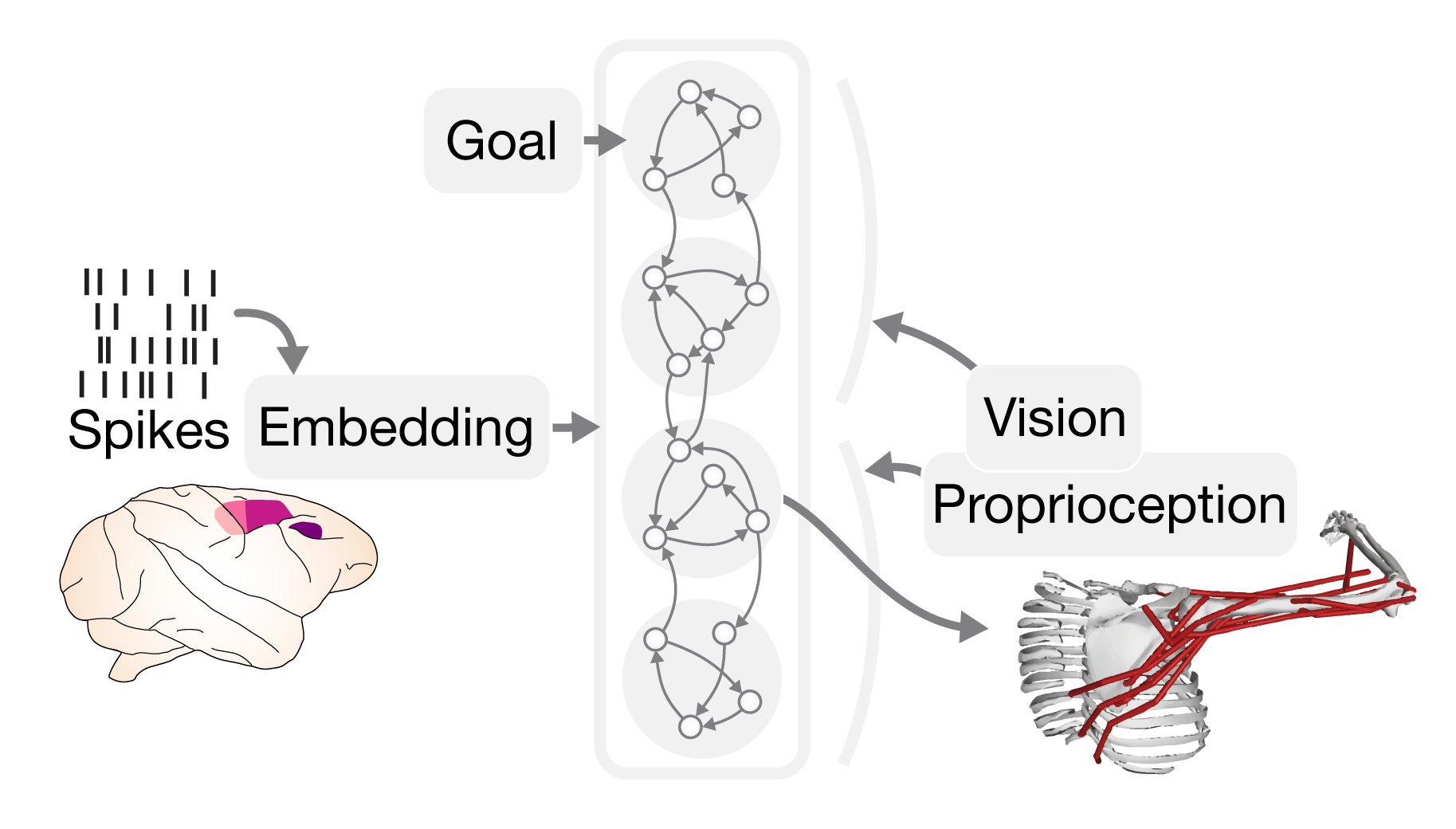
Designing BCIs to understand reach and grasp control
Monkey controlling grasping BCI in virtual reality (related paper)